

CONFRATERNITY OF PENITENTS NEWSLETTER: DECEMBER 2025
Note: The Fast of Saint Martin continues until Christmas Eve. May God bless you during the Fast and during the Feast! A blessed Advent and Christmas Season to you!
INSIGHTS FROM THE SPIRITUAL GUARDIAN: PENANCE AND THE PRINCE OF PEACE
The triple movement of conversion is poverty, penance and peace.
Poverty is letting go. The first step in conversion is detachment. Francis's famous renunciation before the Bishop of Assisi, standing naked before his father, crying. “From now on, I can say only Our Father, who art in heaven,” is not a theatrical defiance, but a radical freedom, an interior liberty before God, For the penitent, poverty means learning to travel light in spirit, in mind and in body, always ready to surrender everything. Francis’ model was Jesus, who was born into poverty with “a manger for a bed.”
Poverty teaches us that God alone suffices. It reminds us that hope cannot be bought or owned; it can only be received. In this way, poverty becomes the mother of peace.
Penance is not punishment but healing. It turns the soul toward love. The Catechism of the Catholic Church in paragraph 1430 reminds us that “interior repentance is a radical reorientation of our whole life, a return, a conversion to God with all our heart, an end of sin and a turning away from evil.” Saint Francis understood that this reorientation begins in humility, the acknowledgement of one's poverty before God. Only the humble can receive mercy.
Penance is therefore a school of love. It trains the heart to seek not its own will but the will of the Father. It frees us from self preoccupation and opens us to the grace peace, the fruit of conversion.
Peace: The Flower of Penance.
St Francis prayed before the crucifix in San Damiano, “Lord, make me an instrument of your peace.” And that happened. That peace did not come easily or cheaply. It came through surrender. Peace is not the absence of struggle, but the presence of God within the struggle. When we learn to see our trials as opportunities to love the wound, then the wounds of life become channels of grace.
St Clare tells us, “Place your mind before the mirror of eternity, place your soul in the splendor of Glory, place your heart in the figure of the divine substance, and transform your whole being into the image of His divinity.”
To live as a penitent is to become transparent to the peace of Christ. We see that peace in the encounter of Saint Francis with the leper, a lesson in the School of Compassion. Saint Francis's encounter with the leper recalls one of the most powerful parables of conversion in Christian history. At first, Francis fled from lepers. They disgusted and terrified him. But one day, moved by divine grace, he dismounted his horse, embraced and kissed a leper. He later wrote, “What had seemed bitter to me was turned into sweetness of soul and body.”
Augustine Thompson observes that this embrace was not mere heroism, but a Eucharistic gesture. It prefigured Francis's later recognition of Christ in the Blessed Sacrament hidden, disfigured yet infinitely lovable. That embrace was the sacrament of his conversion. It united poverty, penance and peace. The leper’s sores became the face of mercy. In that kiss, Francis learned what the gospel means: Love descended from heaven to illustrate penance—the humble self emptying that leads to peace.
This is a daily invitation: to find Christ in the poor, the inconvenient, the wounded, and even in ourselves. The humility of God meets us there in the Eucharist.
A Furnace of Conversion
At the center of every authentic conversion is the Eucharist. The living Christ gives himself to us continually.
St Francis was consumed by this mystery. In his first Admonition, his writing calls out, “Behold daily He humbles Himself as when from His "royal throne" 6 He came into the womb of the Virgin; daily He Himself comes to us with like humility; daily He descends from the bosom of His Father upon the altar in the hands of the priest.”
Francis saw in every Mass the sublime humility he adored at Bethlehem and Calvary. Joshua Benson notes, about Francis’s conversion, “That conversion was sustained by the daily encounter with Christ's poverty in the Eucharist. There he found both his wound and his healing.”
Eucharist is the furnace in which penitents are purified. It's where our self love is melted into love of God. In adoration, we learn to rest in His mercy. In communion, we become what we receive.
In the Jubilee Year of hope, the Eucharist calls us to renewal, not to escape from the world, but to re enter it, transfigured by love.
Conversion in the Modern World
The penitent way is not confined to the 13th century. The world of Saint Francis, torn by greed, war, and pride, mirrors our own. His message is as urgent now as ever. Return to the Gospel. Rediscover simplicity. Live in peace. Penance stands as a beacon in our age of noise. By living the gospel quietly through daily prayer, fasting and charity, penitents remind the church that holiness is possible, that mercy is real, that the gospel can be lived in ordinary life. The rules, practices, fasting, simplicity of dress, detachment from luxury are not antiquated. They are prophetic signs that proclaim that our hope is not in this world.
As the Second Vatican Council teaches in Perfectae Caritatis, Chapter One: ”The ultimate norm of religious life is the following of Christ as set forth in the gospel.” So too, for the penitent, the norm is the gospel. The path is conversion. The destination is peace.
Hope of the Converted Heart
Hope is optimism that is forged in repentance. When we fall, we begin again, not in despair, but in trust. Each confession is a renewal of baptismal grace. Each act of charity rekindles faith. Each humble prayer lifts us closer to the cross. Saint Anthony of Padua said, “The life of the body is the soul. The life of the soul is God.” If the soul is cut off from God, it dies; if joined to him, it lives. Conversion is that daily reconnection of the soul returning home to God. And the joy of that homecoming is the peace promised by Christ. :Peace I leave with you, my peace I give to you.” John 1427.
The Jubilee year calls us to live as people of this peace, not because the world is calm, but because the Lord reigns. Let us pray. “Most high, glorious God. You led Saint Francis from sin to your marvelous light. Lead us to from fear to trust, from pride to humility, from comfort to compassion. Make us instruments of your peace. And we ask this through Christ,.” -- Fr. Joseph Tuscan, OFM Cap, CFP Spiritual Guardian
CONFRATERNITY OF PENITENTS PHOTO ALBUM: LIFE PLEDGE OF SR. JULIAN MICHAEL
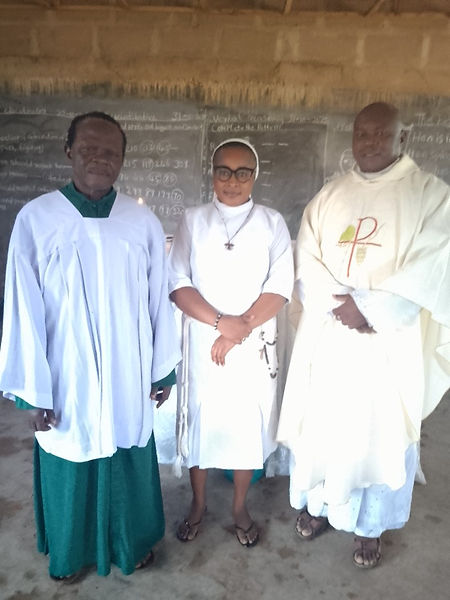
Life pledge of Sr. Juliana Michael
On November 11, Sr. Juliana Michael made a pledge to live the Confraternity of Penitents Rule and Constitutions for life. Sr. Juliana has persisted through set backs and obstacles to become the first vowed religious to also embrace the Confraternity of Penitents Rule of Life.
She writes:
Greetings.
Happy Feast of St. Martin of Tours.
I want to share with you the good news that my life pledge took place this morning.
I've waited for long for this day and finally, God has made it happen.
Am glad.
Attached are pictures evident of the pledge by my spiritual Director and a small worshipping community in a far away village of Enugu Diocese, Nigeria.
Sr. Juliana, may God bless you for your faith, commitment, and good works
HUMOR
-
Lazy is such an ugly word. I prefer the term “Selective Participation.”
-
To err is human. To blame it on someone else shows management potential.
-
Ask your doctor if a drug with 32 pages of side effects is right for you.
-
I’ve put a lot of thought into, and I just don’t think being an adult is going to work for me.
-
The more you weigh, the harder you are to kidnap. Stay safe. Eat cake.
-
Most people don’t think I’m as old as I am until they hear me stand up.
FROM THE ALESSANDRO PRISON MINISTRY: TAKE THE BATON -- AND RUN
An exegesis of 2 Timothy 2:1-2 for the TUMI Ministry by Robert Messer, CFP Novice 1

From the day of the Ascension down to this present moment Jesus has entrusted his Church to the care of ordinary men and women. There never was, there is not now, there never will be a "Plan B" for building the Kingdom of God. It comes down to people. People evangelize. Women and men, through the strength and guidance of the Holy Spirit, equip and empower the Church as it reproduces, multiplies, and spreads throughout the world.
It is the ordinary everyday followers of Jesus Christ who provide, as Dr. Davis says, "the growing Church with all the tools that it needs in order to ‘take the baton" and continue on the journey’ (Davis 39). This was exactly what the Apostle Paul was doing when he wrote his disciple Timothy the letter we now call The Second Letter to Timothy. Paul, writing from prison, encouraged Timothy to continue to share the gospel.
In 2 Timothy 2:1-2 (NLT), Paul wrote:
(1) Timothy, my dear son, be strong through the grace that God gives you in Christ Jesus. (2) You have heard me teach things that have been confirmed by many reliable witnesses. Now teach these truths to other trustworthy people who will be able to pass them on to others.
Or, to restate God's original message to Timothy, and through that message to all of his Church:
Dear Timothy... or, better yet... Dear Church, Be strong in the grace I have given you. Remember the sound teaching you have heard and pass it on to other reliable people who will also be able to pass it on.
The main theme or idea, the meaning of what God is speaking through Paul is that we must pass on the gospel. This is not some treasure to be hoarded. This is not some political opinion to be polite and timid about at family gatherings. This is life or death, eternity-changing stuff.
The text presents three principles that give insight on how God wants his followers to evangelize and reproduce the Church:
Principle number one: Our strength to do anything comes from the grace of Jesus Christ (v. 1). I remember when my (then) wife became pregnant with what would have been our second child. We celebrated like we had achieved something. Then came the tragedy of miscarriage. Just as children are a gift from the Lord, so is the Church. Our vision, our strength, mean nothing if it is not his will and his doing. When we operate outside of his grace, we put ourselves and those around us in a perilous place.
Principle number two: "You have heard me teach things that have been confirmed by many reliable witnesses..." (v. 2a). We must teach the reliable message that we have heard. We live in a world of branding and marketing. Sometimes people slap a "Christian" label on teaching that is the furthest thing from the gospel. In order to really reach people with the Good News, we need to make sure it is the Good News of Jesus Christ. In order to grow and reproduce the Church, we need to make sure it is His Church.
Principle number three: We must pass on the trustworthy gospel to other trustworthy people who will in turn pass the gospel on. Sending wolves into the sheep is not advisable if you want to see the sheep prosper. Likewise, sending shepherds who are unreliable, unskilled, or just plain unready is a recipe for damage to both the sheep and the shepherd. Today's world, where the focus has all-too-often become conversion rather than discipleship, abounds with cautionary tales of all these flavors of failure.
Over the last year, some of us in Unit Six have, with the blessing of staff, started a Sunday morning worship service. All three principles have applied and still apply to our journey as we seek to live as a particular expression of the body of Christ in the Muskegon Correctional faith dorm.
First, from the beginning, we have believed that this service was a movement and a calling of God. In all things we have sought God's leading and strength. It is by grace alone that there even is a faith dorm, much less permission from staff for a service. In everything: from how the services are run to the structure of the governing "elders" who oversee the service, we have turned to God for his guidance.
Second, the preaching and teaching of the service has sought to be biblical in a broad, "plain sense" of the text, reliable way. It has striven to be what Dr. Davis has called being of the "great tradition." Unit Six has Christians of all backgrounds. The solid, reliable teaching based on and rooted in the word is a must.
Finally, the application of principle three has been essential in our Sunday service. Wherever there is a venue with an audience there will be those who just want to take the stage. We've seen this in Unit Six. While part of God's vision for the service is to grow people into their various gifts, there have been times where the elders have had to say "not yet" to the underskilled as well as just plain "no" to some with wrong motivations and agendas.
It comes down to people. Just as when Timothy followed the counsel of Paul, when we follow the counsel of the Spirit and scripture, we will see the Church reach the lost, multiply and spread. We're seeing it in Unit Six. There is no Plan B for building the Kingdom of God. A man who less than a year ago said he "didn't get" the concept of God is now on fire for the gospel. Ordinary men and women, discipled and equipped, are being entrusted by Jesus with his Church. It is a wonder to watch them take the baton -- and run.
-------
Works Cited
The Holy Bible, New Living Translation. 2015.Carol Stream, IL: Tyndale House Publishers
Davis, Don L. 2015. Focus On Reproduction.
Wichita, KS: The Urban Ministry Institute

NO GREATER LOVE: KNOWLEDGE AND BLINDNESS
The first words of Our Lord as He hung upon the Cross are “Father, forgive them; for they know not what they do.” (Lk 23:34)
Who was it who was Crucifying the Lord?
The Roman soldiers who scourged Jesus and nailed Him to the Cross certainly did not know what they were doing. They were simply doing their job for the day by executing a criminal. There probably was excessive cruelty by the Romans, but they had no idea of what they were doing to the Son of God.
The Jewish authorities who induced the Romans to Crucify Jesus, certainly know more about Jesus than the Romans, but they also did not accept Jesus as the Messiah, the Son of God, or the Son of Man. Thus, they also did not know what they were doing. They knew that Jesus was not guilty of a capital crime, but he said things which they believed threatened the temple worship and even the nation.
Why did some people believe in Jesus while others did not believe in Him even after He rose from the dead?
It seems as though most of the people who believed in Jesus were from Galilee, while a few were from Jerusalem. There must have been prejudice about Galilee. Consider this incident. Nicodemus, a secret disciple of Jesus, confronted the Jewish authorities about him, saying, “Does our law judge a man without first giving him a hearing and learning what he does?” They replied. “Are you from Galilee too? Search and see that no prophet is to rise from Galilee.” (Jn 7:51-52) These rulers had knowledge of Jesus (sight) yet they were unable to see behind what they saw. They were spiritually blind. Galilee was the “rust belt” of that time where Israelites who were thought to be ignorant and uneducated lived as opposed to those who lived in the center of Judaism which was Jerusalem with its Temple.
Pope Benedict, concerning St. Paul’s persecution of Christians and his conversion on the road to Damascus (Acts 9:1-19), tells us in Jesus of Nazareth about ignorance and forgiveness. Once again, the theme of “not knowing” appears in one of Saint Paul's autobiographical reflections. He recalls that he himself "formerly blasphemed and persecuted and insulted" Jesus; then he continues: "but I received mercy because I had acted ignorantly in unbelief" (1 Tim 1:13). In view of his earlier self-assurance as a perfect disciple of the Law who knew and lived by the Scriptures, these are strong words; he who had studied under the best masters and who might reasonably have considered himself a real expert on the Scriptures, has to acknowledge, in retrospect, that he was ignorant. Yet his very ignorance is what saved him and made him fit for conversion and forgiveness. This combination of expert knowledge and deep ignorance certainly causes us to ponder. It reveals the whole problem of knowledge that remains self-sufficient, and so does not arrive at Truth itself, which ought to transform man.
When Saul of Tarsus set out for Damascus in order to persecute Christians, (Acts 9:1-2), he had physical sight, but, like the Jerusalem rulers, he lacked spiritual sight. He could not see beyond Jesus being the son of a carpenter from Galilee and “no prophet is to rise from Galilee.” (Jn 7:52) When he saw a light and fell to the ground, he heard a voice saying “Saul, Saul, why do you persecute me?” (Acts 9:4) Saul understood that he was receiving a revelation from God, but he did not know who was speaking to him. He then asks, “Who are you, Lord?” (Acts 9:5-6) When Saul asked “Who are you, Lord?”, he was admitting his ignorance (blindness). He was then able to receive the grace (gift) of God in the form of a reply, “I am Jesus, whom you are persecuting; but rise and enter the city, and you will be told what you are to do.” Of course, Saul was not immediately a knowledgeable Christian. His ignorance (spiritual blindness) was manifested by physical blindness, and he had to be led by the hand into Damascus. For three days Saul was blind and neither ate nor drank. Through prayer and fasting, while physically blind, Saul was being cured of his spiritual blindness. (Act 9: 8-9)
To be a Christian, Saul needed to be in the Church. The Church began on Pentecost Sunday, fifty days after the Resurrection of the Lord, when the Holy Spirit descended on the Apostles. (Acts 2:1-13) An early Christian, living in Damascus, Ananias, was told by the Lord to go to Saul, who was on Straight Street and was praying, and lay hands on him to restore his sight. (Acts 9:11-12) Ananias did go to Saul, lay his hands on him and restored his sight. Then Saul was baptized by Ananias and then took food. While blind and praying and fasting, Saul’s spiritual sight was restored so Ananias could then restore Saul’s physical sight. (Acts 9:17-19) In three days, Saul of Tarsus went from being a persecutor of the Church to a member of the Church and eventually, the Apostle, Paul. This episode reveals the working of God’s gift (grace) in Saul.
We can see another example of the working of God’s grace in the healing of the man born blind. (Jn 9:1-34) Jesus and His disciples encountered in Jerusalem a man who was blind from his birth. The disciples ask Jesus why this man was born blind. Was it the sin of himself or of his parents? Jesus asserts that the man’s blindness was not the result of his sin or that of his parents, but that the works of God could be manifested in him. (Jn 9;1-4) After the blind man was healed of his blindness by Jesus, he was brought to the Pharisees to explain to them what had happened. Since this day was the sabbath day, some Jews did not believe in the miracle saying, “This man is not from God, for he does not keep the sabbath.” Yet others reasoned, “How can a man who is a sinner do such signs?” (Jn 9:16)
There were those who believed the sabbath had to be kept in the rigorous interpretation of the Pharisees, whereas there were others who were not so sure that Jesus should be labeled as a sinner. When the blind man denied that Jesus was sinning when He cured his blindness, he was cast out of the Temple. (Jn 9:24-34) When Jesus saw this, He asked the man He had cured, “Do you believe in the Son of man?” (Jn 9:35) The man then admitted his spiritual blindness saying “And who is he, sir, that I may believe in him?” (Jn 9:36) Yet, he wanted to see, and the Lord granted his request, “You have seen him, and it is he who speaks to you.” (Jn 9:37) The man then received his spiritual sight saying, “Lord, I believe” and then he worshipped Jesus. (Jn 9:38) This man had been physically blind, but he was also spiritually blind since he did not know who was the Son of man. The Lord cured both his blindnesses.
Jesus then tells us the meaning of what He just did. “For judgement I came into this world, that those who do not see may see, and that those who see may become blind.” (Jn 9:39) Of course, the Lord is not speaking of physical sight, but of spiritual sight. Some of the Pharisees, those who did not believe in Him, said to him “Are we also blind?” (Jn 9:40) Jesus replies to them saying, “If you were blind, you would have no guilt; but now that you say, ‘We see,’ your guilt remains.” (Jn 9:41)
Both the man born blind and the Pharisees who did not believe in Jesus saw a great miracle. However, their responses to this miracle were very different. Some could see the work of God in this miracle, whereas others only saw that Jesus was breaking the Pharisee’s interpretation of the sabbath by healing the man. The witnessing of a great miracle is certainly a wonderful grace (gift) from God. Some accepted the gift and believed in Jesus and others refused to believe in the Lord. That is why Jesus tells them “your guilt remains” since they refused to acknowledge their previous spiritual blindness. Unlike the man born blind, they chose to remain in unbelief.
In Jesus of Nazareth, Pope Benedict tells us: Ignorance diminished guilt, and it leaves open the path to conversion. But it does not simply excuse, because at the same time it reveals a deadening of the heart that resists the call of Truth.
In our modern world, there is no shortage of information, in fact we are bombarded with it. Some of it is useless and is meant to distract us from real prayer and even real thinking. Other information can be quite valuable and help us to get closer to the Lord. If we want to know what the Lord suffered for us on the Cross, we can look at the Shroud of Turin. This is where God’s gifts to us of free will and reason come in.
What do we do with what we learn? Naturally, we have to “filter” what comes to us since not everything which comes to us is reliable. God had given to human beings the gifts of a free will and reason. What we do with the knowledge we have depends on our free will and reason. For example, some people believed in Jesus when He cured the man who was blind from birth. Yet, others did not believe.
There is another gift of God which we need besides free will and reason. That is the gift of His grace. We can use the graces God gives us to grow closer to Him, or we can spurn those graces and stay apart from Him. Those who crucified the Lord knew something about Him. However, we know so much more than they did. We can expect that the Lord will hold us responsible for the graces He has given us. – Jim Nugent, CfP

ASBESTOS REMOVAL AND REMEDIDATION
Do you know that, for the past 15 years, the Confraternity of Penitents has operated Vita Dei houses where Catholic men and women discern religious vocations or other life changes? Additional house residents include mature Catholics whose wisdom and charity assist in the discernment. For general information on both men's and women's Vita Dei Houses, see www.vitadeihouse.com
Seven individuals followed religious vocations after residing in Confraternity of Penitents Vita Dei Houses including three religious sisters, a religious brother now on a seminary track in his order, a diocesan seminarian, a diocesan hermit, and two consecrated virgins.
All donations to the Confraternity of Penitents Vita Dei Houses are 100% tax deductible because Vita Dei Houses are a ministry of the Confraternity of Penitents. The Confraternity is a 501c3, non-profit, tax exempt entity under the IRS. Here are four donation options targeted for the Asbestos Removal and Remediation. Make an end of the year donation and help the Confraternity meet this needed expense.
-
Donation of Any Amount toward Asbestos Siding Removal and Plumbing, Heating, Windows, and Electric Upgrade at Saint Joseph's Men's Vita Dei House Hermitage. Saint Joseph's Men's Vita Dei Hermitage can't be insured until the asbestos siding is removed and the house upgraded. Total estimate approximately $95,396.76. Donations to December 1: $2894. Donate on this link.
-
Buy a Beanie – $20. Hand made in the USA by a CFP Benefactor. Colors: Chocolate, Forest Green, White, Tweed. Can be shipped to you or donated to a Fort Wayne homeless, single moms, or hospice ministry. Please specify when ordering or give us a call and we can assist (260-341-7117). Purchase a Beanie on this link.
-
Honoring a Priest in Mary, Mother of Priests Chapel. $180 sponsorship per priest. Priest’s name engraved on a plaque in Mary, Mother of Priest Chapel in Guadalupe Men’s Vita Dei House where he is remembered in Evening Prayer five nights weekly. Please call or write to us with information. All sponsored priests are listed on line at www.GuadalupeVDH.com
-
Dedicating a Room in St. Joseph Men's Hermitage). $5000 room dedication donation includes your choice of room, a 6" x 8" wall plaque with dedication wording, and artwork, photos and/or mementos of your choice to be placed in the room. The CFP will be in dialog with you to set up the room as you would wish. Room Donation on this link.
Checks and money orders made out to "Confraternity of Penitents Renovations Fund" can be mailed to: Confraternity of Penitents Renovations Fund, 1702 Lumbard Street, Fort Wayne IN 46803 USA. With God’s help, these needs can be met. God bless you for your prayers and support!
Please include your name, address, phone number and the following information with your donation (check off):
___General Donation for Asbestos Removal in the amount of $________
___$20 Beanie (donate to charity or mail to me—please circle). Color _______ Size ___ Number of beanies desired___
___$180 Priest Sponsorship. Priest’s Name____________________________________
___$5000 Room Sponsorship. Room sponsored (please circle) Chapel –Kitchen-- Living Room—Dining Room-- Three Seasons Room – Bedroom 1 – Bedroom 2 – Bedroom 3 – Bedroom 4