
Confraternity of Penitents Newsletter October 2026
GUIDANCE FROM THE SPIRITUAL GUARDIAN
“I Am on My Way to God” -- The Transitus of St. Francis, 800 Years Later

This year the Franciscan family marks a remarkable anniversary: eight hundred years since the death, or Transitus, of our Seraphic Father Saint Francis of Assisi on October 3, 1226. For Franciscans, the Transitus is more than the anniversary of a saint’s death. The word means a “passing over,” and it expresses the profoundly Christian way in which Francis approached his final hour: not as an extinction, but as a passage through death with Christ to the Father.
As Francis approached death, he was singing. Thomas of Celano tells us that Francis began Psalm 142, the very Psalm traditionally associated with the celebration of his Transitus: “With a loud voice I cry out to the Lord; with a loud voice I beseech the Lord. My complaint I pour out before him; before him I lay bare my distress.” The words are striking because Francis did not approach death pretending that human suffering was unreal. His body was exhausted and afflicted by illness, his eyesight had largely failed, and the wounds of the Stigmata remained upon his flesh. Yet suffering had become prayer, and prayer had become praise.
Francis also returned to the great song of his final years, the Canticle of the Creatures. As death approached, he had added that extraordinary final praise: “Praised be You, my Lord, through our Sister Bodily Death, from whom no living person can escape.” The dying Francis was doing what he had spent his whole converted life learning to do: turning everything into praise. Sun and moon, wind and water, fire and earth, suffering and forgiveness, and finally death itself were gathered into his song and offered back to God.
A remarkable event from only ten years earlier helps illuminate the meaning of Francis’s final hours. In 1216 another of the great figures of Francis’s age died in Perugia: Pope Innocent III. Innocent had stood at the summit of medieval Christendom. Kings negotiated with him, bishops answered to him, councils assembled at his summons, and only months before his death he had presided over the Fourth Lateran Council. He was also the Pope before whom Francis and his first brothers had appeared, seeking approval for their simple determination to live according to the Holy Gospel.
After Innocent’s death, Jacques de Vitry—the distinguished preacher and churchman who would become Bishop of Acre and one of the earliest independent witnesses to the Franciscan movement—arrived in Perugia. He went to the church where the Pope’s body awaited burial and discovered something that deeply affected him. During the night, thieves had stolen the precious vestments prepared for the Pope’s burial. Jacques found the body of one of the most powerful men in Christendom fere nudum—almost naked.
The sight became for Jacques a meditation on the passing glory of this world. Here was a man before whom princes had stood, now stripped of the visible signs of power and dignity. Everything that had surrounded his earthly office had suddenly become powerless before death.
Ten years later, another man lay dying in Umbria, and he too would lie almost naked upon the earth. But no thief stripped Francis of Assisi. Francis asked to be stripped.
There is no disrespect to Innocent III in this comparison. Innocent bore an immense responsibility for the Church, and Francis himself sought the judgment and blessing of the Roman Church. Yet the contrast between their deaths contains a lesson worthy of every penitent. The Pope possessed the splendid vestments appropriate to his office, and eventually they were taken from him. Francis possessed only a poor habit, and in his final hour he freely surrendered even that.
Francis asked his brothers to place him upon the bare earth. He wanted to meet Sister Death possessing nothing because he had spent his life learning that Christ was enough. Finally, both Pope and Poor Man stood before God as every human being must eventually stand before Him: without possessions, offices, honors, accomplishments, or earthly security, carrying only the truth of what each had become before God.
This is precisely where the Transitus speaks so powerfully to the penitential vocation.
The life of penance is, at its deepest level, the lifelong practice of surrendering willingly what death will eventually take from us anyway. We learn to loosen our grasp upon possessions before possessions are taken away. We surrender our pride before our reputation disappears. We relinquish our insistence upon our own will before circumstances make our plans impossible. We practice detachment from comfort before age or illness deprives us of it. Above all, we surrender sin so that when the hour comes to surrender life itself, our hearts have already learned how to say: everything belongs to God.
Perhaps this is why Francis could say something as astonishing as “Welcome, my Sister Death.” He could call death his sister because everything already belonged to God. Brother Sun and Sister Moon belonged to God. Brother Fire and Sister Water belonged to God. Poverty belonged to God. Suffering belonged to God. His brothers belonged to God. The Order belonged to God. His successes and failures belonged to God. His body, marked with the wounds of Christ, belonged to God. Finally, his life itself belonged to God.
Death could not take from Francis what Francis had already freely surrendered.
That is the secret of the Transitus. We are not merely commemorating the death of a saint. We are remembering the completion of an offering that had begun decades earlier. Francis had been dying to himself long before October 3, 1226. He died to himself when he embraced the leper, when he stripped himself before the Bishop of Assisi, when he surrendered his dreams of knighthood, when the Gospel became his form of life, and when he relinquished control of the Order he had founded.
At La Verna, when the wounds of the Crucified appeared upon his flesh, what had been happening spiritually for years became visible upon his body. Francis was being conformed to Christ. By the time Sister Death arrived, there was very little left for her to take, because Francis already belonged to the Crucified.
As his final hour approached, Francis asked that the book of the Gospels be brought to him. He wanted his brothers to read the beginning of Saint John’s account of the Last Supper: “Before the feast of Passover, Jesus knew that his hour had come to pass from this world to the Father.” Francis understood his own death through the death of Jesus. His transitus, his passing over, was possible because Christ had first passed through death and transformed it.
Francis did not love death because death is good in itself. He loved Christ so completely that even death became another place where Christ could be followed.
There is also something beautiful about Francis asking for the Gospel at the end of his life. His vocation had begun with the Gospel. He and his first companions had opened the Gospel to discover how they were to live, and Francis had spent the intervening years trying, with all his weakness and imperfections, to make the Gospel his form of life. Now, as earthly life slipped away, he wanted the Gospel opened once again. At the beginning was the Gospel. At the end was the Gospel. Between those two moments was a lifetime spent trying to become what he had heard.
Eight hundred years later, this is the challenge Francis places before every member of the Confraternity of Penitents. Our vocation cannot consist merely in admiring Saint Francis, preserving Franciscan customs, or remembering a beautiful spiritual heritage. Francis always points beyond himself to Christ. Near the end of his life he told his brothers: “I have done what was mine; may Christ teach you what is yours.”
Those words deserve to become an examination of conscience for every penitent. What is mine to do? What remains unsurrendered in my life? Where am I still resisting the Gospel? What poverty am I afraid to accept? What forgiveness am I withholding? What obedience am I resisting? What cross am I trying to escape? What am I desperately attempting to possess, protect, or control as though it belonged to me rather than to God?
Francis teaches us that holiness is ultimately the freedom to give everything back.
This is why the discipline of a penitential life matters. Prayer, fasting, simplicity, works of mercy, examination of conscience, obedience, fidelity to one’s duties, and voluntary acts of self-denial are not ends in themselves. They train the heart for freedom. Every genuine act of penance says in some small way, “Lord, this does not own me. My comfort does not own me. My possessions do not own me. My appetites do not own me. My plans do not own me. Even my life does not belong absolutely to me. I belong to You.”
Eventually every Christian will celebrate his or her own transitus.
There will come an hour when possessions, titles, accomplishments, strength, plans, and even the body itself must be surrendered. The great question is whether we will begin that surrender only then, or whether we are learning it now. Saint Francis spent a lifetime preparing for his final poverty, and therefore when Sister Death arrived she found a man already free.
As the Church and the Franciscan family commemorate these eight hundred years since the evening of October 3, 1226, perhaps the most fitting way to honor Francis is not simply to look backward toward the Portiuncula, but forward toward our own final meeting with Christ. Francis has completed his Transitus. Ours is still before us.
Shortly before his death, Francis expressed the simplicity of his hope in words that beautifully summarize the meaning of this anniversary: “I am on my way to God, and I commend you all to His favor.”
May our Seraphic Father Francis pray for the Confraternity of Penitents during this anniversary year. May he teach us to live the Gospel with greater simplicity, to surrender more freely, to do penance more generously, to forgive more readily, and to cling less anxiously to the things that must someday pass away. Above all, may he teach us to love Jesus Christ, the Poor and Crucified Lord, so completely that when our own Transitus finally comes, we too may say without fear: “I am on my way to God.”
— Fr. Joseph Tuscan, OFM Cap.
Spiritual Guardian, Confraternity of Penitents (reprinted on line in www.FranciscanPenanceLibrary2.com

The Secret Sound by Bob Messer, Novice 2, Alessandro Prison Ministry
There is a secret sound that only I can hear.
If I'm lost or if I'm found, I know you draw near.
Fear would speak and seek in its grasp to keep me bound.
Yet I am no mere captive to this secret sound.
A clear voice, your breath, a more steady solid ground
Calls me to a pure land just waiting to be found.
Above, below, around the noise -- your voice is here.
It is the secret sound that only I can hear.
Confraternity Photo Album: Mass on the Solemnity of Saint Francis in the Franciscan Jubilee Year -- October 4, 2026, Portiuncula Chapel on the grounds of Annunciation Women's Vita Dei House, Fort Wayne IN USA. Father Joseph Tuscan, OFM Cap, and CFP Spiritual Guardian, Celebrant

Receiving the Eucharist
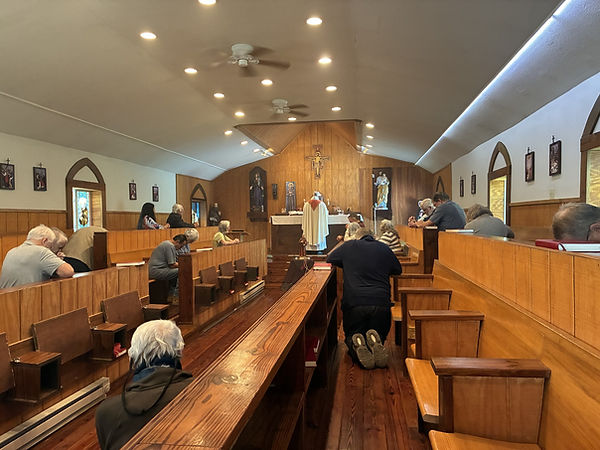
Thanksgiving following Holy Communion
In attendance, CFP Members, Friends, and Affiliates from Fort Wayne, Indiana, USA and surrounding areas as well as residents of Guadalupe Men’s Vita Dei House and Annunciation Women’s Vita Dei House, houses of discernment and community living for Catholics, sponsored by the Confraternity of Penitents (www.VitaDeiHouse.com) Intentions from Confraternity members worldwide were placed on the altar and prayed for during this historic Mass.
NO GREATER LOVE: THE RESURRECTION NARRATIVES
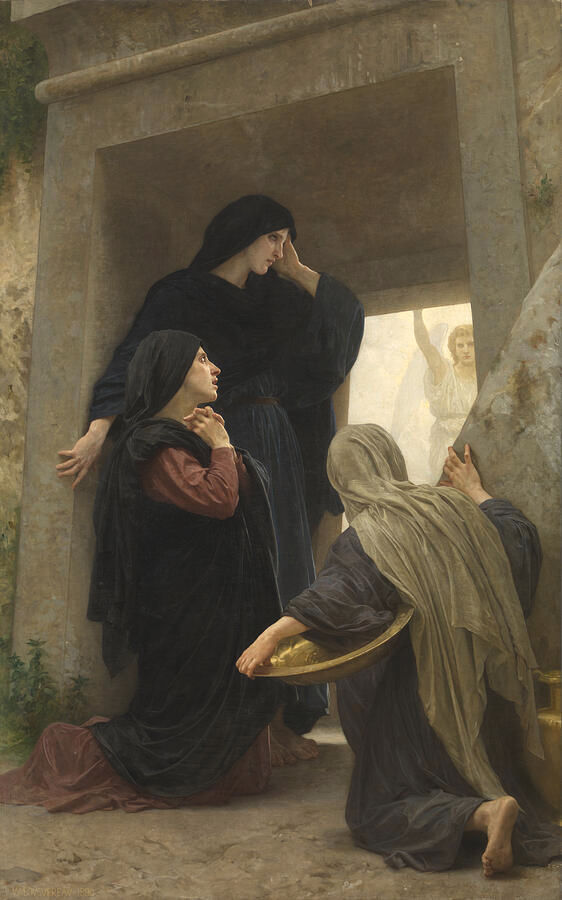
The Biblical confessions of the Resurrection of the Lord are based on several narratives in the four Gospels. These narratives tell of encounters of the Resurrection either in Jerusalem or Galilee. However, in all four Gospels, it was women who first went on Easter Sunday to discover the empty tomb of the Lord. Only after the women had gone there did the apostles Peter and John have the courage to go to the tomb. (Jn 20:3-10)
In St. Matthew’s Gospel, Mary Magdalene and another Mary go to the tomb, and there is an earthquake. Then an angel comes from heaven, rolls back the stone, and sits on it. The angel then proclaims the Resurrection and tells the women to tell the disciples that they should go to Galilee where they will see Jesus. On the way to tell the disciples, the women see Jesus, and He tells them to tell the disciples that they should go to Galilee where they will see Him. (Mt 28:1-10)
When the disciples go to Galilee, He gives them the “great commission”. “All authority in heaven and on earth has been given to me. Go therefore and make disciples of all nations, baptizing them in the name of the Father and of the Son and of the Holy Spirit, teaching them to observe all that I have commanded you; and behold, I am with you always, to the close of the age.” (Mt 28:18-20) The Resurrection is narrated in Chapter sixteen of Mark’s Gospel. However, scholars believe that Mark’s narration ends at verse eight with a “young man” (angel) telling the women at the tomb to tell Peter and the disciples that the risen Lord would go before them to Galilee, although the women were afraid. This abrupt ending was supplemented in verses nine to twenty in the second century with a summary of Resurrection appearances. This longer ending is considered by the Church to be canonical. Either Mark’s original conclusion of his Gospel was lost or he was for some reason unable to finish his Gospel. Like St. Matthew and St. Mark, St. Luke also tells of women going to the empty tomb on Sunday morning. There, two angels proclaimed the Resurrection of Jesus. They then went to tell the disciples but were not believed. However, Peter did go and saw the empty tomb and linen cloths, and he wondered what happened. (Lk 24:1-12) Then, Luke relates two disciples meeting Jesus on the way to Emmaus later on Sunday although they did not recognize Him until He “broke bread” with them, and then He vanished. (Lk 24:13-32) The two disciples then go back to Jerusalem to tell the disciples that they saw the Lord. Then Jesus appeared also to the disciples and showed them His Wounds and also ate broiled fish before their eyes. (Lk 24:33-49) In St. John’s Gospel, Mary Magdalene goes to the tomb on Sunday morning and finds it empty. She then runs to tell Peter and the “other disciple”, probably St. John. John arrives first, but Peter goes in the tomb first and finds only the burial linens. Meanwhile, Mary Magdalene was weeping but saw two angels where Jesus had been laying. Then she sees Jesus, but at first thinks He is the gardener. Finally, she does recognize the Lord. (Jn 20:1-18) Then, John relates appearances of Jesus in Jerusalem on Easter Sunday and again on Divine Mercy Sunday where Thomas is also present and believes. (Jn 20:19-29) Then John describes an appearance of Jesus to Peter and some other disciples by the Sea of Tiberias where He asks Peter three times “Do you love me”. (Jn 21:1-23)
Sometimes, when the Lord appears to His disciples, He is at first not recognized. He is thought of as just another human being. Eventually, they recognize Him. He appears like any human being by speaking with them or even eating with them. However, he is not like any human being since He can pass through locked doors and suddenly disappear. Describing the Resurrection in Jesus of Nazareth, Pope Benedict tells us: This dialectic of recognition and non-recognition corresponds to the manner of the apparitions. Jesus comes through closed doors; he suddenly stands in their midst. And in the same way he suddenly withdraws again, as at the end of the Emmaus encounter. His presence is entirely physical, yet he is not bound by physical laws, by the laws of space and time. In this remarkable dialectic of identity and otherness, of real physicality and freedom from the constraints of the body, we see the special mysterious nature of the risen Lord's new existence. Both elements apply here: he is the same embodied man, and he is the new man, having entered upon a different manner of existence.
The dialectic, which pertains to the nature of the Risen One, is presented quite clumsily in the narratives, and, it is this that manifests their veracity. Had it been necessary to invent the Resurrection, then all the emphasis would have been placed on full physicality, on immediate recognizability, and perhaps, too, some special power would have been thought up as a distinguishing feature of the risen Lord. But in the internal contradiction characteristic of all the accounts of what the disciples experienced in the mysterious combination of otherness and identity, we see reflected a new form of encounter, one that from an apologetic standpoint may seem rather awkward but that is all the more credible as a record of the experience.
We know that even an ordinary event will be described in many different ways by many different witnesses to the event. Some of the descriptions may even seem contradictory and yet the event was real. The initial non-recognition of the Lord is understandable and even to be expected. In John Chapter 9, the Lord gives sight to a man who was blind from birth by putting mud in his eyes and then telling him to wash the mud out in a pool. When he returned being able to see, the people who knew him as a blind beggar were divided over whether it was really him or someone else. The man himself and later his parents confirmed that he was the blind beggar. (Jn 9:8-9, 18-20) Some could not believe that this man could now see although the evidence was before their eyes. The Apostle Thomas did not believe the reports of the Lord’s Resurrection until Jesus was standing before him with His wounds. Then Thomas exclaims, “My Lord and my God!” (Jn 20:27-28)
The Lord himself confirmed that He was not a ghost by allowing people to touch Him (Lk 24:37-40, Jn 20:17) or to eat with Him. (Lk 24:41-43) The first book of Samuel relates how King Saul, when he was about to enter battle with the Philistines, asks God by various means what he should do, but he received no answer. He then went to Endor to ask a medium to bring up the ghost of the prophet, Samuel, who had recently died. Mediums were forbidden by the Mosaic Law. When she brought up Samuel, he appeared as a “god” to her. Then Saul asked the medium. “What is his appearance?” She tells him, “An old man is coming up; and he is wrapped in a robe.” (1 Sam 28:14) Samuel then tells Saul what he had told him while he was still alive, that God had rejected him as King of Israel, (1Sam 15:26) and that Saul and his sons, the very next day, would be with him in the realm of the dead. (1Sam 28:19) Jesus was clearly not a ghost like Samuel. Jesus could not be “brought up” but appeared to whomever He chose.
Pope Benedict points out that the Greek word used by St. Luke to describe Jesus eating with the Apostles literally means “eating salt with them.” Salt is regarded as a guarantee of durability. It is a remedy against putrefaction, against the corruption that pertains to the nature of death. To eat is always to hold death at bay-it is a way of preserving life. The "eating of salt" by Jesus after the Resurrection, which we therefore encounter as a sign of new and ever-lasting life, points to the risen Lord's new banquet with his followers. It is a covenant-event, and in this sense it has an inner association with the Last Supper, when the Lord established the New Covenant. So the mysterious cipher of eating salt expresses an inner bond between the meal on the eve of Jesus' Passion and the risen Lord's new table fellowship: he gives himself to his followers as food and thus makes them sharers in his life, in life itself. As Pope Benedict explains, the Lord’s “eating of salt” with His disciples reveals the new bond between the Lord and His disciples and with us. He is sharing everything with us, including His life, His eternal life. Although St. Paul never met the Lord in His physical life on earth, He did meet Him on the road to Damascus to persecute Christians. This encounter is related three times in the book of Acts. (Acts 9:1-18, 22:6-16, 26:12-18) This was neither a vision nor a dream. Around noon, while traveling with companions, Paul sees a bright light which blinds him. He then hears a voice saying, “Saul, Saul, why do you persecute me?” Since Paul saw no one, only the light, he did not know who was speaking to him. He asks, “Who are you, Lord?” Paul knew the voice came from God, but who exactly was speaking with him? He got the answer quickly. “I am Jesus, whom you are persecuting.” The appearances of the Lord where He appears as a Man and even eats with his disciples occurred before His Ascension in Heaven, while His appearance to Paul was after the Ascension. Jesus was no longer a resident of earth but was now a resident of Heaven. Jesus had said to the Apostle Thomas, “Blessed are those who have not seen and yet believe.” (Jn 20:29) St. Paul was one of the first of the numerous “blessed” ones. – Jim Nugent, CfP

I COULDN’T STOP CRYING
On September 13th, I celebrated my 61st birthday with a fourth visit to the National Shrine of Our Lady of Champion, the only approved Marian apparition site in the United States, in Champion, Wisconsin. Champion, once named Robinsville, is near Green Bay, Wisconsin. This was my 4th visit to the shrine. A peaceful place where one finds refuge and healing on the peaceful grounds where the Blessed Mother appeared to Adele Brice on October 9th, 1859 with the following words: “Gather the children in this wild country and teach them what they must know for salvation. Go and fear nothing. I will help you. Adele Brice was declared Servant of God on January 30th, the 195th anniversary of her birth.
The Feast Day of Our Lady of Champion is October 9th, celebrated yearly. For more information on the Champion Shrine and its story visit. www.championshrine.org The Shrine has a bigger than life statue of Our Lady. When one goes down into the Oratory, one cannot help but feel the love of a Mother waiting for her children. Behind the statue is a huge relic case housing many relics including the Wood of the True Cross, the Veil of the Blessed Virgin, and a first class relic of Saint Francis of Assisi.
My reason for this particular visit was to see and venerate on my birthday day, the First Class Relic of Saint Carlo Acutis, whose Eucharistic Miracles website is published it the book The Eucharistic Miracles of the World. This can be purchased at the CFP Holy Angel's gift shop (www.cfpholyangels.com) as well as other books, prayer cards, medals, rosaries, and so on this amazing Patron Saint of the Internet. Saint Carlo Acutis had a great love and devotion go Our Lady's Rosary and the True Presence of Jesus in the Eucharist. I was gifted with the Grace to kiss and venerate this precious relic of his hair. I can't deny; I was so moved, I just could not control the crying. They were tear of great joy as I was so humbled and honored, as I poured out my many troubles to this great saint who loved Jesus and Mary so much.
I heard him tell me. “Pray the Rosary daily.” I now pray four rosaries a day. “Stay close to Jesus in the Eucharist and sacraments, the only true Highway to Heaven.” I left with these word's in mind. If a 15 year old kid can do it, then we dan do it. Even Saint Carlo said as Our Lady Of Champion did, “Go! And f nothing, I am Always with You. Saint Carlo’s Feast Day Is October 12th. – Bryan LaHaise, CFP Affiliate
HUMOR
-
My friend keeps telling me, “Cheer up, man. It could be worse. You could be stuck underground in a hole full of water.” I know he means well.
-
There was a big paddle sale at the boat store. It was quite an oar deal.
-
My wife called to tell me that she saw a fox on the way to work. I asked her how she knew it was on its way to work. She hung up on me.
-
A friend told me that she didn’t understand cloning. I said, “That makes two of us.
-
Thief steals wheels of police car! Cops work tirelessly to nab suspect.
-
I didn’t think orthopedic shoes would help, but I stand corrected.
-
What do you call a belt made of $100 bills? A waist of money.
-
What do you call a magician who has lost his magic? Ian
-
Today I saw an ad that said, “Radio for sale. Volume stuck on Full.” I thought, “I can’t turn that down.”
-
Sometimes I wonder what happened to the people who asked me for directions.

MEAN IT
Your faith is real, it’s not a game, if you say you’re a Christian “MEAN IT”.
Christians need to have a real close relationship with God, to be able to withstand the challenges of a secular society. The world is a very challenging place.
If you are a superficial Christian (i.e. only on the surface, never taking your faith any deeper), you will not cope with the day-to-day pressures and issues against our faith today.
• WE NEED TO KNOW GOD
• WE NEED TO WALK THE WALK WITH CHRIST
• WE NEED TO NEED AND DEPEND ON GOD
• WE NEED TO LET THE HOLY SPIRIT GUIDE US
If we are able to do these things, we will have the type of relationship with God that will help us get through life’s issues and challenges that will be aimed at us and our faith.
By showing we “MEAN IT” we show that being a Christian means everything and others will have the opportunity to “see” not only what Christ means to us but also what Christ can do for them.
Don’t just talk the talk but walk the walk and MEAN IT.
Be Bold Be Strong! God bless you! Pastor Tony Billings CFP Affiliate

CHRISTMAS SHOPPING AHEAD
Consider the CFP Holy Angels Gift Shop Over 9,000 products including scapulars, rosaries, prayer cards, greeting cards, clothing, and more. The shop is managed by all volunteer help, and all proceeds support the Confraternity of Penitents in its mission to live a life of penance (conversion) and spread the message worldwide. God bless you for your prayers and support!